I spent seven years pretending to be a lawyer before I had to flee the country. I didn’t flee prosecution; rather, I was fleeing all the other people who had been pretending to be lawyers along with me.
I was not a fraud in the traditional sense — I was a student competing in mock trial, from high school, through university, with every intent to go to law school after that. Then sometime in junior year it dawned on me: if I went through with my plan I’d spend the rest of my life surrounded by the same people I’d been competing against. I packed my bags and moved to Asia to teach English.
But ten years after fleeing fake trials, I became entangled in the fake diplomacy of Model United Nations as the coach of my school’s MUN team.
The flashbacks came on strong sitting in the back of a committee room listening to students delivering aggressive speeches on antibiotic resistance or education in conflict zones. It was another mock trial: a room full of bright, verbally-inclined students being trained in arrogance and BS.
To be clear, I have only praise for the humans young and old who partake in, organize, and coach these events. They are me. It is the format themselves that are not deserving of the extraordinary effort poured into them. Under the promise of prestige and development, they teach the very best students to be fakes.
After my quasi breakdown in the back of the MUN committee, I confessed to my principal that I could no longer lead the students. He understood and — sagely or at least humoring me — agreed that it was not a great fit for our students. I was permitted to pivot our school to debate.
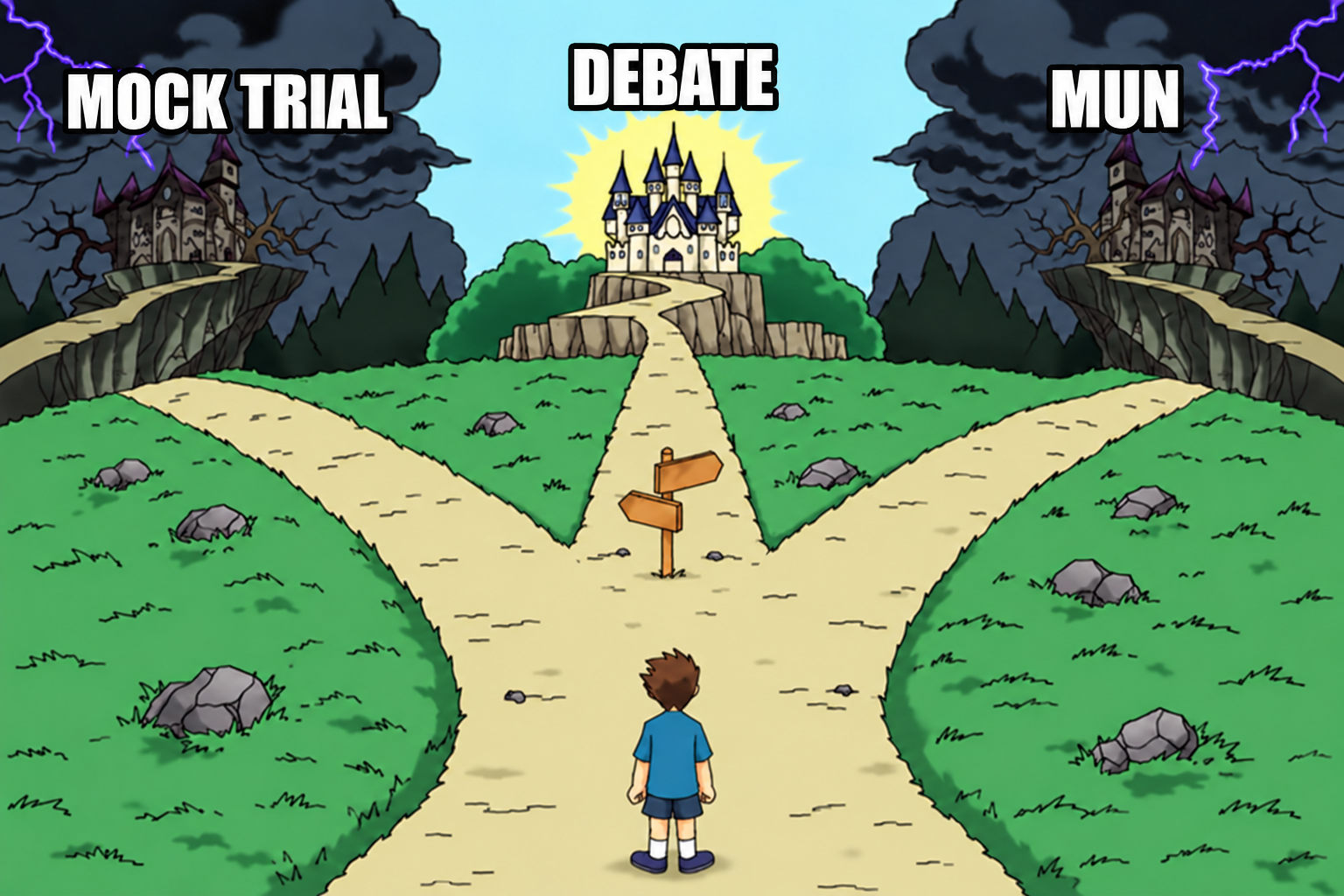
Debate is arguably the most virtuous of these rhetorical sports. After judging my first round at a tournament, I basked in its authenticity. The arguments weren’t profound, but that didn’t matter. It had been a debate; the students were debaters, without qualification. What’s more, the fixed format and quick feedback loop meant that my students went into a tournament knowing exactly what to expect and got better after each round. They left, even having lost, energized and excited for the next competition.
Even so, the unspoken or danced-around truth of debate is that while it doesn’t train frauds, it absolutely does train sophists. Debaters are not taught to seek the True or the Good so much as the Win. (Ancient Greek drama buffs will immediately recognize that this is the plot of Aristophanes’ Clouds — the same play which Plato later blamed for getting Socrates executed.)
And it is my hunch that this indifference to objective truth is behind debate’s other major shortcoming. In a typical debate round’s examination of what matters in the world, the humanities are almost entirely absent. History is limited to a few recent events and philosophy is relegated to meme status. Literature is nonexistent. It’s current events through and through.
Imagine then the sensitive (and ambitious) verbally intelligent young man. What waits for him when he goes seeking the life of the mind? No matter the path he takes at any given high school, it’s going to be either fake lawsuits, UN reports, or op-eds. Every year, hundreds of thousands of students take part in mock trial, MUN, and debate.
What about drama or speech competitions?
Yes, I myself qualified for states in oral interpretation of poetry. I was Creon in a post-modern high school production of Antigone. You will note, however, that I specified the young man was “ambitious.”
OK, in that case, aren’t lawsuits, reports, and op-eds better training than poetry?
You are part of the problem I am trying to address.
The truth of human experience is found in the humanities. I want my students searching for first principles in philosophy, rereading a poem a dozen times, tracing great themes of civilization through works of history, and building their own mental libraries of heuristics and motifs. This is how they’ll make sense of life and the world.
Ultimately, unable to find a competition that pulls students into literature and history as strongly as debate pulls them into policy, I designed Atlas Seminar and now am making it public.
| Format | Structure | Feedback cycle (approx.) | Content | Relationship to reality | Relationship to truth |
|---|---|---|---|---|---|
| Mock Trial | Rigid | 2 hours | Laws in a fictional setting | “Mock” | Indifferent |
| MUN | Loose | 2 days | International policy | “Model” | Indifferent |
| Debate | Rigid | 45 minutes | Policy generally | A real debate | Indifferent |
| Atlas Seminar | Rigid | 5 minutes | Literature and history | A real seminar | Seeking |
An Atlas Seminar is organized around texts and axioms that make sense of them. It requires seminarians participants to creatively “map” a connection between one of each.
For example, a game might pair four of Shakespeare’s sonnets with three axioms on poetry drawn from Sister Miriam Joseph’s The Trivium, creating two columns, like this:
Texts (Territories)
- Sonnet 16
- Sonnet 18
- Sonnet 52
- Sonnet 60
Axioms (Legends)
- “Poetry communicates an experience that cannot be communicated any other way.”
- “The form of a poem is felt to be inevitable.”
- “Poetry relies on figurative language.”
In each round, a participant selects one text and one axiom to connect. They might map that connection by drawing, acting, reciting a passage, sharing a memory, or posing a question (you can imagine a third column with these methods). Then, the others analyze the connection and vote on which text and axiom pairing they think it represents.
It’s competitive. Participants are rewarded for making the best maps as determined by others voting on them most accurately, and they are also rewarded for voting accurately. But success rests on mutual intelligibility. A connection succeeds only when others understand it. The format rewards depth, humility, and cooperation — this is what I’ve seen playing the game in my own classes for years.
In an Atlas Seminar, students dig deeper into texts and connect them to our overarching concepts in unexpected ways. When one student or team presents their map (their drawing, scene, quote, memory, etc.), everyone else is rapt. I’ve collected a corkboard full of student illustrations mapping Dickinson’s language, Seneca’s claims, and Bradbury’s themes.
Atlas Seminar is excellent as a game for English and history teachers. Now let’s see it as a weekend-long competition.
I don’t expect hundreds of thousands of students to ever compete in Atlas Seminar. But I do hope that one day, on the way to some weekend tournament, students are huddled in the back of a bus discussing not some think tank proposal but a poem.